Wednesday, July 13, 2016

A Time When a Little Instruction is Better than a Lot

The other day, I had a young friend show me a method of factoring that he favoured.  He was told that "nobody" knew the reasoning behind this method; it just worked.  I couldn't let that go.  There is no mathematical method that just "always works" and no one knows why.

Not having been able to find any explanation on the internet, my friend thought I should post an explanation.  I thought about it.  I even began to prepare a post.  But I couldn't do it.  To show him a full explanation would be like giving the answer to a problem at the first sign of struggle.  I don't want to rob him of an opportunity to work through some algebraic thinking.  Instead, like someone stuck while climbing a wall, I am confident he simply needs a bit of a leg up.

Here then, is my challenge:  I will show you my work, along with a couple of questions to think about.  Can you reason your way toward a proof that your method of factoring will work for any quadratic expression (and why is it an expression, rather than an equation??) that factors?

First, let me remind you of what happens when we multiply two binomials with a leading coefficient of 1.


Next, let's factor the quadratic expression you came up with the other day. 


Why is the 4^2 important?  Did each step make sense?  Which ones do we skip when we apply the method?  Will this method always work?  Why?

Thursday, November 26, 2015

Golden Ratio and Fibonacci Sequence

Monday, November 23 was, apparently, Fibonacci Day.  I Googled it, and it apparently is really an official "Day."  Who knew?  Someone on my Facebook feed acknowledged the special day by posting about Fibonacci numbers found in nature.

http://io9.com/5985588/15-uncanny-examples-of-the-golden-ratio-in-nature

Of course I saved it to show my little ones, who love this sequence.  What matter that it's bedtime when there is math to be explored?  The article mentioned the golden ratio too.  I haven't brought it up before, but since they now have the background in operations on fractions and decimals, they were ready. 

I think this is the first time we have brought out a calculator for math.  The one that comes on the latest version of windows even records your calculations as you go along.


We took consecutive numbers in the Fibonacci Sequence and divided the larger by the smaller:  2, 1.5, 1.66667, 1.6, and so on.  Every so often, we stopped to see what patterns the kids noticed. 

At first, they said things like, "They all have a six.  Well, most of them have a six."  While true, we discussed whether this was a mathematically useful observation in this situation.  Does that tell us anything about the whole number?

The answers all begin with 1.6.  Except for the first ones.  That's something, isn't it.

Then they noticed that the answer gets smaller, then bigger, and smaller, bigger, smaller, and so on.  That's interesting.  There's a pattern in the sequence of answers.  Anything else?

Spider Girl mused, "What's happening?"  A good question!  It's not just the resulting numbers, but there is a sequence, a chain of events. 

We decided to graph to get a better sense of "what's happening."  Off to Excel!


BatBoy pointed out that the graph has a couple of bumps at the beginning and then makes a flat line.  It looks like a flat line, yes.  But we know the numbers are not exactly the same.  What's happening?  They stared at the graph a moment as I tried to figure out how to expand it vertically.  (I never did.)  Oh!!  They're (the results are) getting closer to a number!

Does the pattern continue if we keep going?  SpiderGirl wanted to know.  I added a couple of columns and modeled how to use formulas on Excel.

The sequence really seems to tend towards a number.  We had to take more and more decimal places to see the differences between terms higher up in the sequence.  This number that we are getting closer and closer to is called the Golden Ratio.

BatBoy wanted to keep going to find the exact number.  No, I told him, the Golden Ratio doesn't repeat and it doesn't end, just like pi.  We aren't going to be able to find the exact value.  But we can approximate it.  Why is it interesting outside of the Fibonacci Sequence?

Because, shells and galaxies, hurricanes, the human face, human fingers and animal bodies, reproductive dynamics and health, animal flight patterns, even DNA molecules.   Wow.  Both SpiderGirl and BatBoy were floored.  It was worth staying up a few minutes late, I think.


Friday, May 29, 2015

Alternatives to Acceleration in Math

For awhile now, I've been getting to know many parents of gifted children, a population where there seems to be a disproportionate interest in math.  I identify a lot with many of these kids.  I had a propensity for math, and it was a subject in which I took pride because I could get the high scores that made me stand out.  At the same time, I didn't like the math that I learned, not until calculus.  When I look at how the math-gifted kids are dealt with, I am somewhat befuddled.  Here we are, gifted and many of us homelearning:  We acknowledge that there is no one size that fits all, not in pacing, not in interests, and not in learning styles.  Yet, it seems to me that nearly all the math-gifted kids are offered the same accommodation, differing only in pacing.

In the schools, both brick and mortar and online, advancement in math seems easy to deal with.  The student takes some tests and gets accelerated to the appropriate grade.  Now, for many kids, that is a good way to go.  Acceleration means more difficult material delivered in a neat package.  The package is important because many parents are unsure of their own knowledge in math.  Many kids thrive on the challenge.

Sometimes, acceleration isn't possible or it isn't enough.  Then students might be offered contest problems or lateral thinking puzzles.  Very occasionally, they are shown math from other cultures or given some math history.  These topics and exercises are fun and interesting, but they're also piecemeal and lacking in the area of actually educating in math.

Additionally, what about those whose thinking is divergent, who learn through problem solving, or whose language or development makes them unready to tackle coursework at their mathematical level?

How about depth instead of pacing?  Making connections?  Cultivating intuition?

BatBoy is 7 now.  His placement tests put him somewhere in the middle of grade 5 for math.  He doesn't know all of his multiplication tables.  He can do short division but not long.  Multiple digit multiplication is messy for him.  He has a need to know numbers in depth.  He loves prime numbers, families of exponents, roots, and factor trees.  He senses there is more to know about fractions and wants to dig in.  He is not ready for the procedural task of traditional algebra.  Contest problems freak him out.  So what do we do?  What have we done?

I write this because we have delved into deeper math with BatBoy, and I am convinced that other children would also love to explore math in this way.  BatBoy's past year has looked like this:  Along with regular skills, such as listing combinations, and surface explorations, such as of fractals, he's also continued to explore numbers in depth.  The topic of prime numbers led us to explore 0 and 1.  0 and 1 are special; in what other ways are they special?  What are the roles of 0 and 1 in multiplication, fractions, exponents, negative numbers?  What is interesting about other numbers, such as 6, 7, 8, 9, 36, 49?  What happens when we try to take 0 to the power of 0?  What does it mean to get one answer when you look at it one way (anything to the power of 0 is 1) and another answer when you look at it another way (0 to any power is 0)?  It means there's no solution, because in math, a solution is valid if you can reach it no matter how you get there!  How do we divide by fractions?  The math books will say that you multiply by the reciprocal.  This is a huge pet peeve of mine, because it is around this time that many students seem to throw up their hands and decide that math is meaningless and arbitrary.  Who can blame them really?  Nobody can explain why we multiply by the reciprocal; nobody even attempts an explanation.  BatBoy would not accept (nor remember) such a procedure.  What do we do?  We make a foray into the idea of mathematical proof.  Turn a concrete example into a representation that could be any numbers m and n, and we prove that dividing by 1/2 is the same as multiplying by 2.  (For older students, I have begun with the idea of the fraction as a division.  Once they see that dividing by 2 is the same as multiplying by 1/2, the reverse translates easily.  BatBoy did not accept the reverse as obvious.)

BatBoy may not extend these mathematical habits of mind into other problems right away.  However, the seeds are planted.  By filling out the world of mathematics beyond definitions and skills, we create context.  This is the kind of context a "mathy" kid needs.  This world of math is the context in which connections between numbers and concepts are made.  And if we can be patient with the slow and unsystematic way a child makes these connections, the foundation is laid for encouraging the development of mathematical intuition.

Sunday, March 15, 2015

Pi Day

Not quite in time for Pi Day (Yesterday, we were busy eating pie with friends.) is a video of Physics Girl estimating pi with darts.  When I watched the first bit, I almost gave up on it.  It's only human to aim for the centre of a target.  But it's worth a watch to the end! 

The kids loved it, especially the part where they throw multiple darts with a blindfold on!


Sunday, December 14, 2014

Infinity

An acquaintance recommended a site full of "math in daily life" videos.  Lately, math around here has become a little dull.  SpiderGirl is practising multiplication tables; BatBoy hasn't had anything new for awhile; so the inspiration was welcome.


"The Infinite Life of Pi" caught BatBoy's imagination.


He calls these his "infinite drawings."  He made one that looked just like a visual representation of Fibonacci's sequence too.  (It was a series of adjacent squares.)  From there, we went on to explore ways infinity shows up.  His drawings reminded me of fractals, so I found some videos to show him.


And of course, the Ted-Ed had a video on fractals too.


Finally, we looked at what happens when we allow long division to go into decimals instead writing a remainder or changing to a mixed fraction.


Monday, August 25, 2014

Take Me to the Moon

Daily math doesn't have to mean practical situations that everybody gets into all the time.  Sometimes, daily math just means math that happens to come up. 
 
Today, A. made a comment that she could jump six times as high on the moon.  When I challenged her idea that she was jumping as high from the floor as the top of her head at the peak of her jump, we decided to measure.
 
The very high tech measurement device:  a piece of sidewalk chalk in a chalk holder, taped onto a headband.
 
First, A. marked the chalk's height against the wall while she was standing.
 
 
Then she jumped while applying enough pressure for the chalk to draw on the wall.  She did this several times to achieve the highest jump she could.
 
 
She measured the distance between her initial marking and the highest point on the chalk line:  20 cm.
 
 
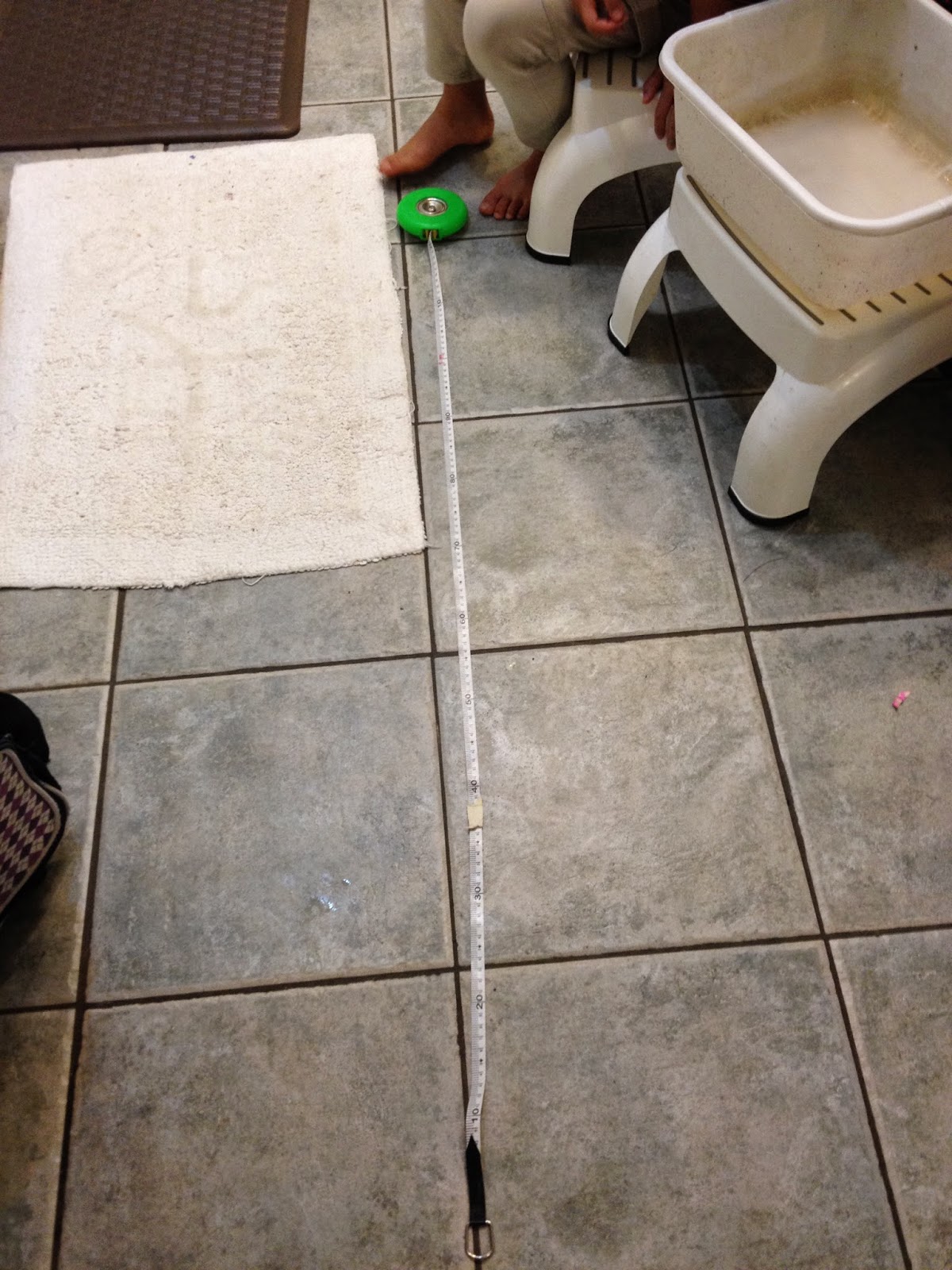
Multiplying 20 cm by 6 gives 120 cm, or 1 m 20.  How long is that?  She rolled out the measuring tape, and we also held it up vertically to get a sense of how high the bottom of her feet would get on the moon.  A. was impressed.


Thursday, July 3, 2014

Baby Steps

On the topic of supporting the development of mathematical communication, today I want to address patience.  One of the greatest obstacles to learning is the fear of making mistakes.  In other areas of study, we know that mistakes are the path to learning.  In Math class, we get points taken away for every mistake we make, and if the teacher doesn't understand the steps you made to get to the wrong answer, we get no points at all.  But in fact, we don't want children to know what steps to show; we want them to understand how to show enough so that their audience can follow them. We, as guiding adults, need to exhibit patience with our children as they learn to communicate their mathematical ideas.

When children are learning to write in the early years, we encourage them to get their ideas on paper without fussing about perfect spelling and punctuation.  When they are learning to express themselves as toddlers, we give them the words we think they are trying to use.  We need to do the same with "showing steps."  Before we ask children to show all of their work on paper, we need to talk out their reasoning with them.  We have the advantage in that we can make educated guesses about how they came up with a solution to a problem or what steps they might take.  The back and forth of a conversation allows the child to make baby steps in learning to communicate by both watching and hearing the adult model, and making small attempts themselves and getting immediate feedback.  As we converse, we might write the parts on paper that we think would go into "showing work."  Eventually, the child will make their own written attempts.  

The process of learning what steps to show takes time and is unevenly paced.  A child not only needs to learn the language and vocabulary of math, but also takes years to understand that different audiences require different steps to be shown or different ways to show them.  We need to embrace that what goes on inside the head of a child is usually more than they can express well.  Rather than the patience of waiting -- waiting for the child to mature when one day they will magically "get it" --  what is required is the patience of building.  Celebrate each small success.  Laugh over misunderstandings.  Learn from mistakes.  It's all valuable.

Wednesday, June 11, 2014

Supporting Communication Through Understanding A Child's Process

Earlier I wrote about the importance of supporting the development of mathematical communication in a child.  I thought break my thoughts up into chunks.  Today, I'd like to talk about listening to understand a visual thinker.

One of the difficulties in communicating with a visual-spatial person, especially a child, about how a solution is reached is that they often understand things in pictures.  For one thing, there isn't really a sequence of steps they took to arrive at "an answer."  Rather, everything is there all at once in the picture.  For another, since we converse using language, ask children to explain themselves using language, and often model using language to explain, children expect to explain themselves using language.  As children get on in Math, this might evolve into a habit of trying to explain steps in a process using numbers or equations.  We need to break out of these two boxes. 

Saturday, June 7, 2014

Communication II

Continued from an earlier post...

Now where was I?  (That's the trouble with taking quiet time in the morning, rather than at night:  there's no way to steal from your sleep to get a blog post finished.)  Right, communication.

What brought on these thoughts about helping children communicate their math?  It was a combination of things that grabbed my attention this year.  One contribution was the oft-repeated assertion that visual-spatial thinkers "just know" solutions to problems.  The other was the similarity in approaches used by teachers in a variety of subject areas:  In The Writer's Jungle, Julie Bogart emphasizes the importance of helping children express themselves by first listening to them and scribing for them, then offering your own words and structures to clarify or help them to better communicate their ideas.  Grammar, spelling, punctuation are all there to support communication; they aren't ends in themselves.  When my daughter brought her music composition to show her teacher, her teacher didn't critique her very unusual timing (In fact, she commented that she found it interesting.) but rather helped her by showing her how to add the bar lines and time signatures that would allow readers to understand the sounds she wanted to create.  Visual art, too, has been described as sharing with the world what you see the way you see it.  Learning to communicate in math needs the same type of support as learning to communicate in visual, linguistic, and musical mediums.  

In North American society today, we tend to think of Math and Sciences as going hand-in-hand, perhaps because the Sciences so regularly use Math to communicate and understand their own ideas.  However, Math is not itself a Science.  There are parts of Math that are irrefutable and reproducible; those are the parts that seek truth in the way Sciences do.  Math is also about beauty and creation; those parts are like the Arts.  To validate only the mathematical ideas of a child that agree with a textbook is akin to accepting only the drawings of a child that are exactly like the given sample.  To ignore or correct a child's own mathematical ideas is to dampen the mathematical spirit in him.

How then do we support the development of mathematical communication?

To be continued in... 

Thursday, June 5, 2014

Communication

Lately, I've been hearing a lot about kids who "just know" an answer to a problem and don't know how they got it.  I must say, at first I felt a bit perplexed.  In all my years of teaching and tutoring, I have never come across a single student who "just knew" an answer consistently and couldn't show work.  Even if they began by saying that they didn't know how they knew, we could always tease out the line of thinking that led to their answer.  What I believe, then, is that it's not okay to become complacent with these very intuitive kids.  Showing work for marks is not necessarily a goal for everyone, but being able to communicate thoughts is an important step in learning.  Yes, communication is necessary for the sharing of ideas that leads to piggybacking and synergy.  More importantly, though, successful communication ensures that a child will understand that their mathematical ideas are valuable, that their logic is valid, that they are capable of "doing math."


Continued...

Monday, March 3, 2014

Math and Science: Measuring Angles

Up until now, our studies in Math and Science haven't really overlapped much.  There has been some reading of thermometers and volume measures; we haven't even graphed results.  Use of the protractor is yet another form of measurement, though one that isn't used in our daily lives, so I consider this experiment to have led to as much math learning as science.

Wednesday, February 26, 2014

Factor Trees

BatBoy and SpiderGirl have been playing with multiplication lately.  The Beast Academy workbook (3B) has many problems requiring the use of multiplication and BatBoy is learning a good portion of the lower tables just through use.  In the car one evening, he was talking to me about finding all the combinations that would give a product of 12 (I think) and so I offered to show him factor trees.  SpiderGirl immediately wanted to know all about it too.

When I was in school, factor trees looked like this:

Thursday, January 30, 2014

Snowflake Symmetry

We got a new microscope in the summer and around November, we saw some beautiful photographs of snowflakes.  I've also been telling the kids that real snowflakes have six-point symmetry, which they, of course, wanted to see for themselves.  I planned (without saying anything to anyone else) that at the first snowfall, we should bring our microscope outside and take a look.


The first snowfall of the year happened a week or two before Christmas.  I was tired from running around to rehearsals and concerts and parties.  I figured, we can wait until the morning.  Then, I thought, "You know what?  It will probably snow again." 

It never did.  Now, I'm thinking about getting the garden ready for spring.

Look Mom!  I can SEE the six-point symmetry.  She has excellent sight.

Scaling Tangrams

BatBoy loves tangrams and tangram puzzles.  Over the years though, our sets have a few pieces.  When it was suggested that was play with tangrams as part of Chinese New Year celebrations, it seemed like a good excuse to make a new set.  SpiderGirl also wanted to make a set for herself.

Enchanted Learning has a page on tangrams and how to make them.  They do it by folding.  Since we have graph paper, though, it seemed like a good time to introduce scaling diagrams.  We scaled the template on the website by a factor of 4.  The kids did their own multiplication. 


Then they glued the graph paper onto cardstock and cut out their new tangrams!  They made some zodiac animals off the Enchanted Learning page and did some puzzles from Fun O Rama.


Thursday, January 2, 2014

Place Value and Bases Other Than 10

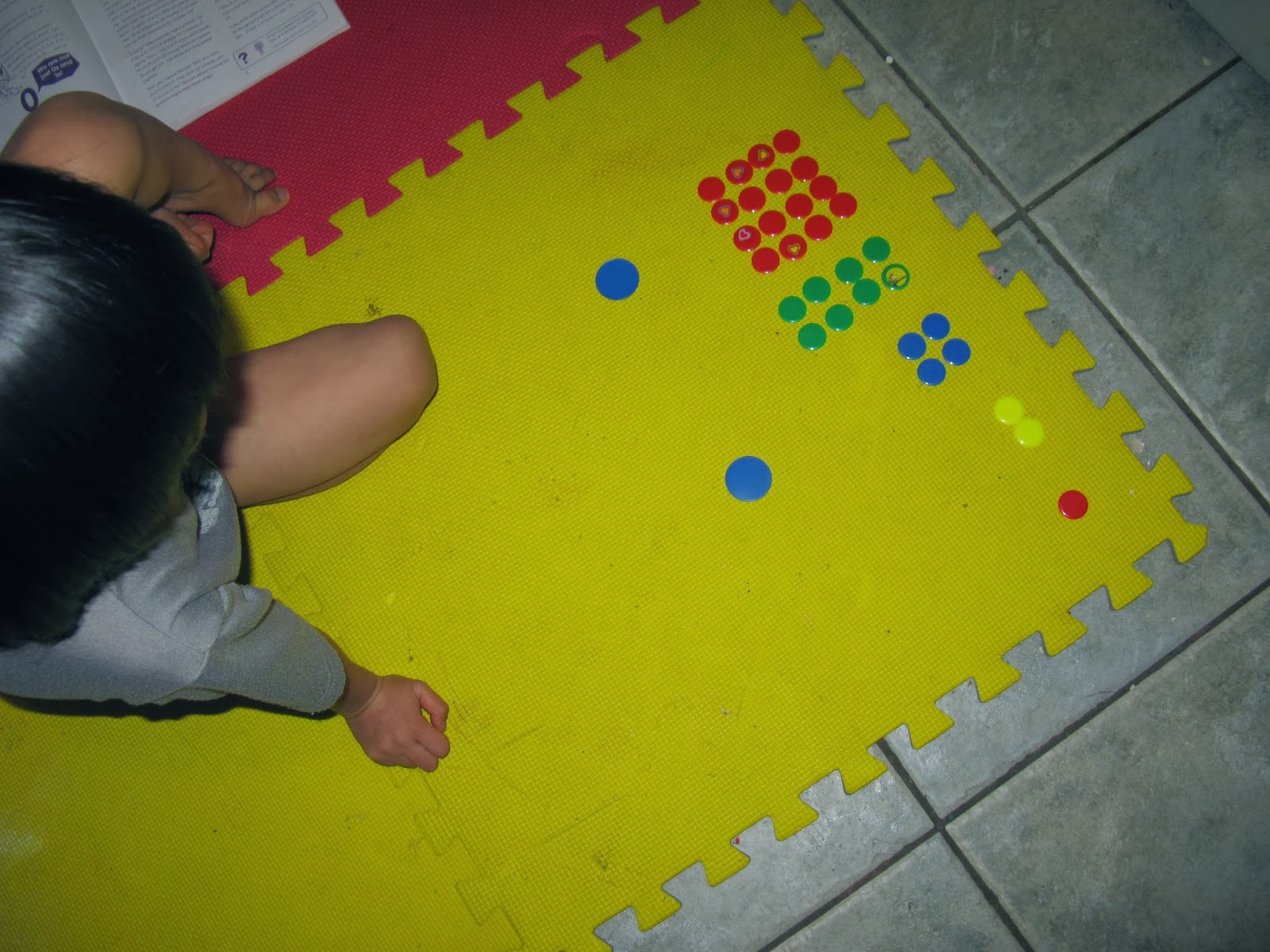
Our family loves Penrose, the Mathematical Cat.  Here, one story about numbers in base 2 inspired explorations of number bases in general.  These snapshots show BatBoy using counters to translate numbers between base 10 and other bases, while SpiderGirl looks on and gives input as she is sewing.

10100 in base 2 is 20 in base 10.


Setting up to work in base 3.

Tuesday, December 24, 2013

Supporting a Global Learning Style

A few months ago, I wrote about exploring the "right-brained" style and sequence of learning, the details of which are written about extensively at "The Right Side of Normal" website.  In my previous post, I speculated that perhaps we are a family of "right-brained learners."  We are not.  (My son and I are "whole-brained" when it comes to math.  This plausibility of this claim is supported by a recent article citing studies that investigate brain activity of youth with a predilection for math and/or music.)  However, I do have one child who learns math in a way that constantly surprises me.  She does, indeed, follow the "right-brained" way of doing things. 

Monday, October 28, 2013

Zooming the Number Line

Presented with a problem of rounding in Museum of Mysteries, by David Glover, BatBoy makes a very common mistake:  He wants to round 7651 to 7600.  At least I know he is not just memorizing the answers (or at least it is very clear when he has just memorized an answer) because he makes this same mistake every time he comes to this point in the story.  7651 seems to be closer to 7600 than to 7700 because there appear to be more similarities between 7651 and 7600.


Yet, when presented with a number line, BatBoy can find the midway point between 7600 and 7700, and then deduce that 7651 is, in fact, closer to 7700.  But we need to draw this diagram over and over again.

Sunday, October 13, 2013

Creating a Culture of Math: Books

Children love books.  Books are a window to the world greater than their own.  Within books, children can play with personas, meet friends, explore ideas, discover people different from themselves, and have great adventures.  Books can be either informative or fantastical.  Either type can be a good way to ensure math is included in your family culture.

For the youngest children, we have counting books and shape books readily available.  One of our favourites is The Very Hungry Caterpillar, by Eric Carle.  I also recommend Math Fables and Math Fables Too, by Greg Tang .  They are everywhere you can find books.  Pick one or two that your child enjoys and put it on your bookshelves, or borrow them from your local library.  Read them with your child; enjoy the story and count the pictures together. 

After counting, math books seem to vanish from the bookstore shelves.  We need to look a litte harder to find them.  After counting, children like to see numbers in use.  Some they might like include

Saturday, October 12, 2013

Operations in Fractions

BatBoy understands fractions in the concrete sense, as equal parts of a whole.  We haven't really touched on concepts like finding common denominators or multiplying fractions.  Instead, he has spent time and energy really getting to know a few basic fractions and how they "work together."  As he has learned to add and subtract, and then multiply and divide, he has been able to apply these operations to these basic fractions (halves, thirds, quarters, eighths, and occassionally, sixths).  Using his visual understanding, he has solved problems involving adding or subtracting fractions of the same "family" (halves, quarters, and eighths; or thirds and sixths) including their mixed numeral relatives.  He is able to find answers with negative values, such as the solution to 1/8 - 1/4.  Today, he was playing with the sequence of dividing numbers by two.  Beginning with 8, he divided by 2, again and again, until he got to 1/16 and couldn't (his words) "multiply 16 by 2" without paper.

SpiderGirl plays with concepts less and so, seems less drawn to mathematics than BatBoy.  But given problems, she solves them quickly.  She gets mental blocks when she is anxious.  If she thinks that there is a "right" way to solve a problem (a way that she is less than confident with), or that I expect a particular answer, solved in a particular way, she freezes and claims she has no idea.  But, if the problem is presented in a low pressure environment, she can shine brightly indeed.  SpiderGirl understands fractions visually.  Even when fractions are not of the same "family," she can puzzle it out using manipulatives.  She used manipulatives to figure out to find common denominators in order to add or subtract.  When she gets more comfortable with multiplication, factors, and multiples, I have every confidence she will gain a more methodical way of finding common denominators.   When manipulatives are not available, SpiderGirl is also to present reasonable guesses to problems involving fractions, decimals (to hundredths), and percents.  And she is learning that there is value in her ability to estimate.

Monday, September 23, 2013

When It Rains, It Pours.

Have I mentioned that BatBoy likes math?  Yep, I think he does.  He likes math games, he likes manipulatives, and he loves worksheets.  What?  Who loves worksheets??  Seriously, this boy drags them around like a security blanket.  He brings them everywhere we go.  Whenever he can spare a minute, whether he's waiting for his sister to finish her class or riding in the car or hanging out at home, he works on his worksheets.  He even drags the worksheets to bed and refuses to sleep until he is done what he is working on.  Between his obsession and his willingness to brush off and learn from errors, BatBoy is gaining arithmetic skills at a rapid rate.