Sunday, December 14, 2014

Infinity

An acquaintance recommended a site full of "math in daily life" videos.  Lately, math around here has become a little dull.  SpiderGirl is practising multiplication tables; BatBoy hasn't had anything new for awhile; so the inspiration was welcome.


"The Infinite Life of Pi" caught BatBoy's imagination.


He calls these his "infinite drawings."  He made one that looked just like a visual representation of Fibonacci's sequence too.  (It was a series of adjacent squares.)  From there, we went on to explore ways infinity shows up.  His drawings reminded me of fractals, so I found some videos to show him.


And of course, the Ted-Ed had a video on fractals too.


Finally, we looked at what happens when we allow long division to go into decimals instead writing a remainder or changing to a mixed fraction.


Monday, August 25, 2014

Take Me to the Moon

Daily math doesn't have to mean practical situations that everybody gets into all the time.  Sometimes, daily math just means math that happens to come up. 
 
Today, A. made a comment that she could jump six times as high on the moon.  When I challenged her idea that she was jumping as high from the floor as the top of her head at the peak of her jump, we decided to measure.
 
The very high tech measurement device:  a piece of sidewalk chalk in a chalk holder, taped onto a headband.
 
First, A. marked the chalk's height against the wall while she was standing.
 
 
Then she jumped while applying enough pressure for the chalk to draw on the wall.  She did this several times to achieve the highest jump she could.
 
 
She measured the distance between her initial marking and the highest point on the chalk line:  20 cm.
 
 
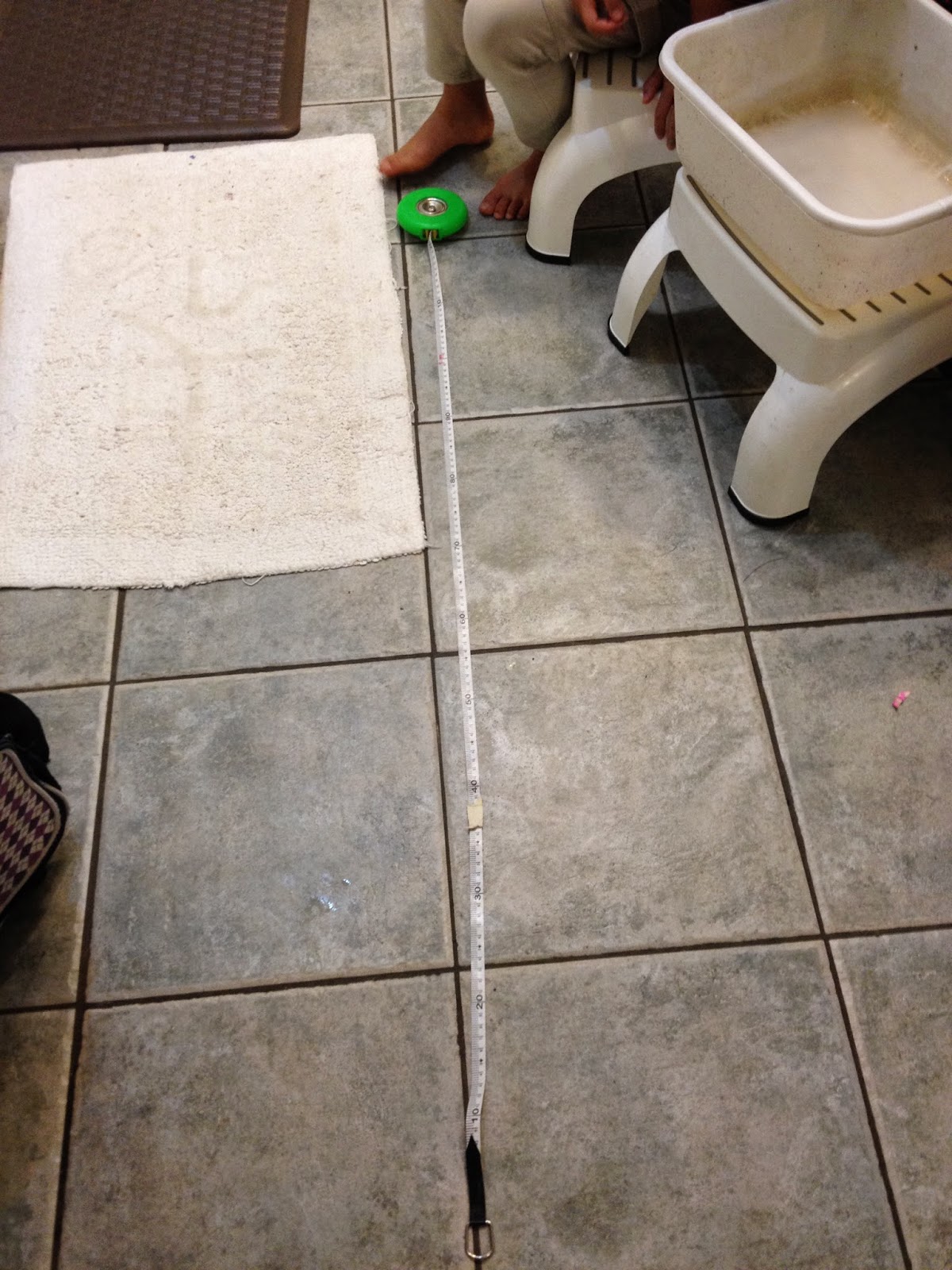
Multiplying 20 cm by 6 gives 120 cm, or 1 m 20.  How long is that?  She rolled out the measuring tape, and we also held it up vertically to get a sense of how high the bottom of her feet would get on the moon.  A. was impressed.


Thursday, July 3, 2014

Baby Steps

On the topic of supporting the development of mathematical communication, today I want to address patience.  One of the greatest obstacles to learning is the fear of making mistakes.  In other areas of study, we know that mistakes are the path to learning.  In Math class, we get points taken away for every mistake we make, and if the teacher doesn't understand the steps you made to get to the wrong answer, we get no points at all.  But in fact, we don't want children to know what steps to show; we want them to understand how to show enough so that their audience can follow them. We, as guiding adults, need to exhibit patience with our children as they learn to communicate their mathematical ideas.

When children are learning to write in the early years, we encourage them to get their ideas on paper without fussing about perfect spelling and punctuation.  When they are learning to express themselves as toddlers, we give them the words we think they are trying to use.  We need to do the same with "showing steps."  Before we ask children to show all of their work on paper, we need to talk out their reasoning with them.  We have the advantage in that we can make educated guesses about how they came up with a solution to a problem or what steps they might take.  The back and forth of a conversation allows the child to make baby steps in learning to communicate by both watching and hearing the adult model, and making small attempts themselves and getting immediate feedback.  As we converse, we might write the parts on paper that we think would go into "showing work."  Eventually, the child will make their own written attempts.  

The process of learning what steps to show takes time and is unevenly paced.  A child not only needs to learn the language and vocabulary of math, but also takes years to understand that different audiences require different steps to be shown or different ways to show them.  We need to embrace that what goes on inside the head of a child is usually more than they can express well.  Rather than the patience of waiting -- waiting for the child to mature when one day they will magically "get it" --  what is required is the patience of building.  Celebrate each small success.  Laugh over misunderstandings.  Learn from mistakes.  It's all valuable.